
You feel every tiny panic and goofy triumph when a narrator speaks directly to you, like they’re whispering secrets over coffee, and that closeness hooks you fast; the voice is sharp, funny, and messy—mouth open, crumbs on the shirt—so lines land hard and clip into short videos, fans reenact them with dramatic eye-rolls and bedside lamps, and suddenly the protagonist is your friend you owe an honest text to—and you’ll want to see what they do next.
Key Takeaways
- First-person POV creates immediate intimacy, letting viewers feel like they’re inside the narrator’s head.
- Distinctive narrator voice yields shareable, quotable lines that perform well as short clips.
- Micro-moments and sensory beats translate into snackable scenes ideal for quick videos.
- Confessional tone builds parasocial connections, making creators’ reactions feel personal and relatable.
- Strong quirks and emotional honesty drive engagement through comments, duets, and repeat viewing.
The Power of Intimacy: Feeling Every Thought and Emotion

Because I want you to know just how close this gets, I’ll start blunt: first-person POV makes you a spy inside a character’s skull, and it’s deliciously invasive.
You lean in, breath held, smelling coffee grounds and fear, and every thought lands like a punch or a tickle. You feel emotional resonance in the small stuff—the lame joke, the skipped heartbeat—so scenes hit harder, faster.
It’s an immersive experience, sensory-first: you hear the rustle, taste regret, touch the frayed sleeve. I’ll poke you with honesty, wink at the awkward bits, then shove you into the next heartbeat.
You’ll find intimacy breeds trust, and trust lets the story whisper secrets straight to your ribs, where they ache and stick.
Instant Relatability Through Voice and Tone

You feel it the second a narrator snaps at you, or whispers a guilty secret into your ear, because their voice hands you the emotion like a warm mug.
I’ll point out how a distinctive narrator—full of odd little rhythms, salty jokes, breathy confessions—gets you laughing, bristling, or choking up in one line.
Picture a character chewing gum, rolling their eyes, then confessing a regret, and you’re already hooked, because that tone makes everything immediate.
Immediate Emotional Access
Connection matters. You feel the narrator’s pulse, you catch their breath, and you’re pulled into emotional resonance before page two.
I talk to you like we’re in the same room, I point at a crooked mug, you laugh, you already care.
First-person hands you immediate emotional access, it lets you smell hot coffee, hear a trembling voice, see the small lie that spirals. Immersive storytelling happens fast, no distance, just raw feeling and the micro-moments that teach you who someone is.
You don’t have to decode motive, you live it. That speed fuels BookTok clips, and yes, it cheats the usual slow reveal—deliciously.
You’re hooked, you swipe, you want the next hit, and I’m grinning because me too.
Distinctive Narrator Voice
I’m not asking permission to steal your attention—I’m taking it, with a wink and a chipped mug in hand.
You lean in because my voice sounds like someone who knows the map and drew you a shortcut. I use distinctive language, the kind that snaps pictures in your head, smells like burnt coffee, and clicks like a cheap spoon against porcelain.
You hear a unique perspective, a narrator who admits flaws, cracks jokes, then hands you the truth on a napkin. You feel seen, instantly, because I speak like a neighbor who’s also a spy—familiar, surprising.
Short lines land like beats, longer ones pull you through the room. You laugh, you roll your eyes, you buy the idea.
That’s the power of voice.
Snackable Scenes Built for Short-Form Videos
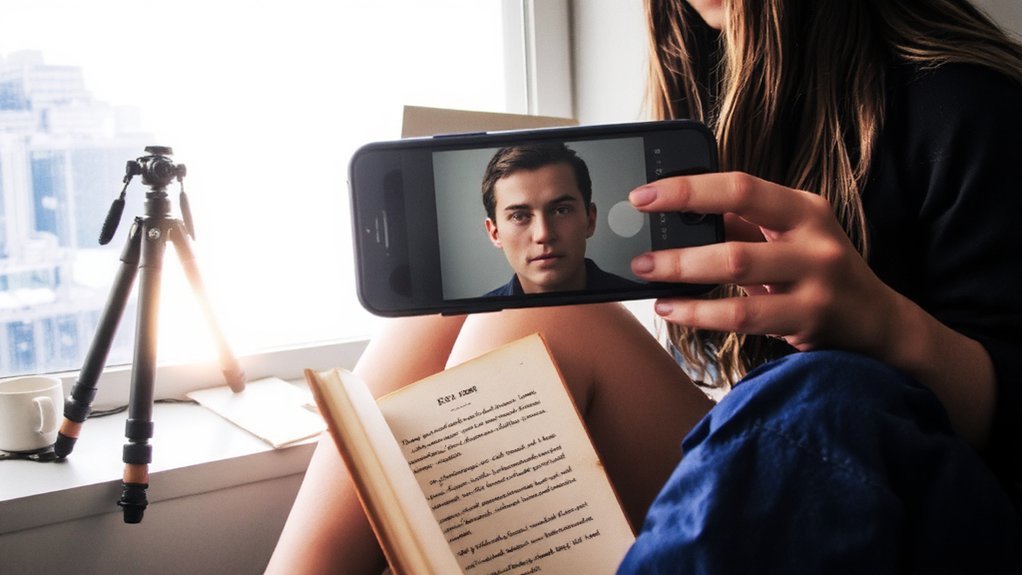
When a scene’s built for thirty seconds, you learn to love the snap: quick beats, bold gestures, and a single line that lands like a punchline.
When scenes live in thirty seconds, every beat snaps — bold gestures, one punchline, visuals that do the heavy lifting
You craft snackable storytelling, trimming to a vivid kernel that hooks, surprises, and leaves a taste. You pick one strong image—a slammed door, neon dripping rain, coffee spilling slow—and you let the camera eat it.
Visual engagement is king, so you stage movement, color, and texture, then cut for rhythm. You talk to the viewer, wink, admit you’re cheating a little with montage, but it works.
You trust sensory detail, a tactile sound, a bitter smell, a heat on skin, to sell emotion fast. You leave space, let viewers fill in the rest.
Quotable Lines and Shareable Moments
Snackable scenes give you the visual hook, but lines make people hoard clips like snacks in their pockets. You hear a phrase, you pause, you save it—those quotable moments become currency.
I watch you clip, caption, and send, because a sharp sentence hits like cold cider, bright and surprising. You want shareable lines that sting, soothe, or make you snort-laugh on a crowded bus.
I suggest phrasing that’s vivid, tactile, a salted lemon on the tongue: tactile verbs, crisp rhythms, a tiny twist at the end. You don’t need epic monologues, just a pulse—an arresting turn of phrase that begs to be repeated.
Give viewers a bite-size emotional jolt, and they’ll carry it everywhere.
Performing the Text: Reenactments and POV Transformation
You jump into voice-actor reenactments, mimicking breath, cadence, and that little throat-clear the narrator uses, and you feel the scene swell around you.
Then you flip perspective, performing a POV scene adaptation where you mouth another character’s thoughts, tilt the camera, and make the room tilt with them.
It’s messy, fun, and a little theatrical—exactly the kind of playful experiment that turns readers into performers, and viewers into witnesses.
Voice-Actor Reenactments
How do you take a paragraph off the page and make it breathe like a living person? You lean in, listen to cadence, and play with voice modulation until the sentence smiles or snarls.
I’ll admit, I butcher a line or two before it sings, but that’s part of the fun. You practice character embodiment by shifting jaw, posture, tiny vocal twitches, making the narrator’s room smell like rain, or their coffee taste too strong.
You film quick cuts, whisper a confession, then boom — a full-throated rant. Viewers feel invited, like they’re eavesdropping on a soul.
It’s playful, precise, a craft and a prank. You perform first-person text, and suddenly strangers believe it’s their story.
POV Scene Adaptations
When I flip a paragraph into a scene, I don’t just read it — I stage it, like I’m sneaking a play into someone’s living room.
You watch me map beats, pick props, and whisper lines, then test pov techniques — close third, breathy first, unreliable wink — until the room tilts.
You lean in, you hear cloth rustle, coffee clink, a throat clear.
I chop narrative structure, splice tempo, shove the line into your face, and watch you react.
Sometimes I laugh at my accents, sometimes I nail the choke in a syllable.
You’ll mimic, remix, loop a clip, and suddenly that sentence lives as a tiny, addictive drama.
It’s rehearsal, performance, and micro-theater rolled into a scrollable thrill.
Building Parasocial Connections With Protagonists
Even if you’re skimming the back cover at midnight, squinting through the lamplight like a detective on a sugar high, I’ll bet you’ve already started chatting with the protagonist in your head.
You lean into first-person narration because it hands you a voice like a friend who knows your coffee order. That reader identification snaps into place fast, you feel seen, you feel implicated.
Character immersion arrives through sensory beats—your palms sweat, the room smells like rain and cheap perfume, you whisper the jokes before the line lands.
Sensory beats pull you in—palms sweat, rooms smell like rain and cheap perfume, jokes land early.
You forgive flaws, you root for risky choices, you keep the protagonist’s secrets like gossip. It’s intimate, cozy, intense.
In short, first-person builds a parasocial spark, and you can’t help but fan it.
Leave a Reply