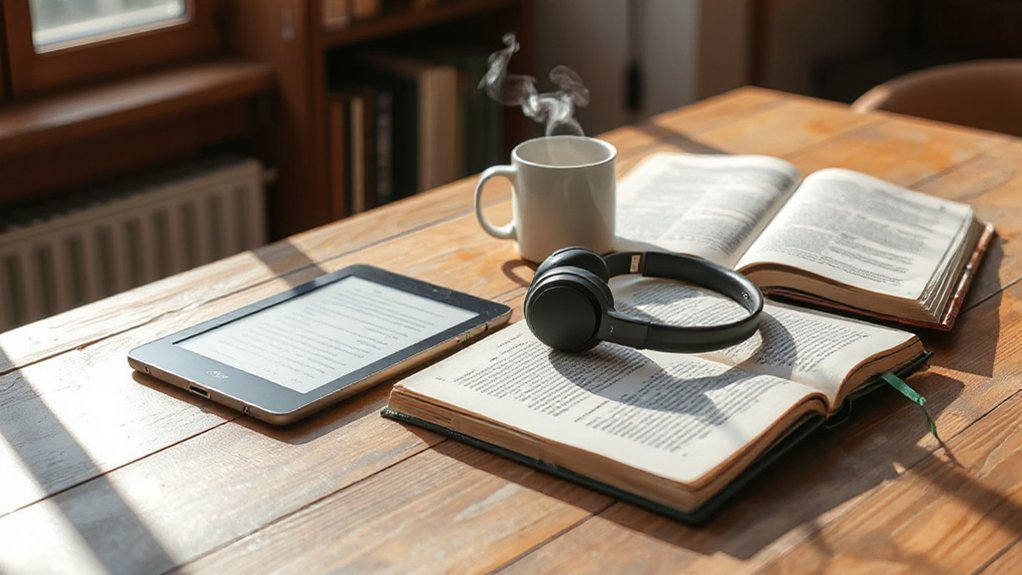
Is it true that one format actually gets you through more books than the other? You’ll want to test that on your commute, or while you’re chopping onions—yes, multitasking counts—because ebooks let you skim, highlight, and speed through pages with your eyes, while audiobooks slide into your ears and free your hands; I’ll show you which wins for focus, for routine, and for the weird moments in between, so pick a device and a snack and let’s see what fits your life.
Key Takeaways
- Audiobooks boost reading volume by letting you listen during commuting, chores, and exercise, turning idle time into productive reading.
- Ebooks speed up reading with skimming, adjustable text, and search, making it easier to consume more material quickly.
- Choose format by content: narrative audiobooks suit storytelling, while complex nonfiction often benefits from ebook or print for comprehension.
- Combining formats (switching between ebook and audiobook) increases total reading by fitting content into varied daily routines.
- Personal habits and engagement matter most: the format you enjoy and can consistently use determines how much you read.
How Ebooks Make Reading Faster and More Flexible

If you’ve ever juggled a paperback, a tote bag, and a lukewarm coffee, you’ll appreciate what I’m about to say: ebooks speed up reading and bend to your day like a practiced contortionist.
You tap, the type shifts, and suddenly you’re skimming at twice the pace, highlighting a sentence with your thumb, zooming in on a diagram, then shrinking text to stash more on screen.
I’ll admit, I once scrolled so fast I nearly missed a punchline. Digital accessibility features save you time, they read aloud, change contrast, and remix layout to suit your eyes.
Yes, watch for screen fatigue—adjust brightness, pick serif fonts, take micro-breaks. You’ll read smarter, not just faster, and feel clever doing it.
The Advantages of Audiobooks for Multitasking and Consistency

One thing I’ll say up front: audiobooks turn your life into a multitasking magic trick, and yes, I still drop things when I’m applauding the narrator.
You’ll love the audiobook convenience—walks, dishwashing, commuting, workouts, you name it, you’re reading. I narrate aloud in my head, grin at a clever line, and keep chopping onions without crying, except once, dramatic flair.
Multitasking benefits show up as steady progress; chapters tick by while you cook, fold laundry, or wait in line. You get consistency, a daily rhythm, a habit that sticks because it fits your life.
Chapters tick by during chores and commutes—steady progress, a rhythm that turns reading into an effortless daily habit
Try timers, bookmarks, speed tweaks, and a great narrator. It’s efficient, playful, and downright habit-forming.
What Research Says About Comprehension and Retention

Because your brain doesn’t care which medium whispers the story to it, what matters is how you listen and what you do after, and research gives us a surprisingly pragmatic picture.
I’ll tell you straight: studies show modest comprehension differences, often favoring print for dense material, while audiobooks can match comprehension for narrative flow. Retention rates depend on engagement, not just format.
- For complex ideas, pause, re-read, or replay — comprehension differences appear.
- For stories, vivid narration boosts retention rates, you picture scenes, smell rain.
- Active note-taking locks facts in, whether you tap or jot.
- Repetition and testing beat passive listening every time.
You’ll innovate your routine, try experiments, and iterate fast.
How Personal Habits Influence Which Format Helps You Read More

When you stack your mornings around coffee and commute, your reading life changes — I know, I’ve been there, mug in one hand, earbuds in the other, pretending I’m multitasking like a productivity influencer.
You’ll find your reading preferences tilt toward formats that fit those beats. If you move, listen, and snack on ideas between stops, audiobooks slot neatly into your daily routines, vibrant soundscapes filling idle pockets.
If you crave tactile focus, bookmarks, and the smell of paper, ebooks or print serve concentration better.
I nudge you to map habits: note when attention spikes, where hands are free, what background noise you tolerate.
Then choose the format that amplifies those moments. Don’t overcomplicate it, adapt, and enjoy reading more.
Practical Strategies for Combining Ebooks and Audiobooks

If you split your reading between screen and speaker, you’re already halfway to literary greatness — or at least to finishing that intimidating TBR pile.
I’ll show you how to blend formats so your format preferences and reading schedules actually help, not hinder. You’ll swap scenes, senses, and momentum, and yes, you’ll feel clever.
- Alternate formats by chapter, so your commute is audio, your nightstand is ebook.
- Match mood to medium: dense theory on screen, feel-good fiction via earbuds.
- Sync progress: bookmark digitally, pause audio at cliff edges, so shifts are seamless.
- Use speed controls and font tweaks, make pacing your sidekick.
You’ll tweak, fail, laugh, then finish. Victory tastes like cold coffee and a closed book.