
You probably don’t know that some of the most revered classics were written to be devoured, not deciphered. Picture yourself on a rainy afternoon, fingers cold, a mug steaming, as you glide through sharp dialogue, plain sentences, and scenes that smell like dust and coffee — and you won’t bog down once. Stick with me, and I’ll show you nine novels that sneak up on you, hook you, and refuse to let go.
Key Takeaways
- Choose classics with plain, modern prose like To Kill a Mockingbird and The Old Man and the Sea for immediate readability and emotional clarity.
- Look for short, focused narratives (Of Mice and Men, The Great Gatsby) that deliver big themes in compact form.
- Prefer strong narrative voice and dialogue (Catcher in the Rye, Jane Eyre) to carry you quickly through the story.
- Pick books with clear symbolism and short scenes so themes feel vivid without dense exposition.
- Start with slim, accessible editions or annotated versions that explain context and keep momentum.
To Kill a Mockingbird by Harper Lee

If you haven’t met Scout Finch yet, you’re in for a treat — she’s the kind of narrator who’ll tell you exactly what she thinks and make you feel like you’re sitting on her front steps, swinging your feet.
You walk Maycomb with her, you taste summer dust, hear porch talk, and you’re smirking at her blunt takes.
Walk Maycomb beside her — taste summer dust, hear porch gossip, and grin at her razor-sharp, plainspoken takes.
I’ll warn you: the book folds bright childhood innocence around hard truths, it nudges you toward racial injustice without punching you over the head.
You’ll chuckle at Scout’s stubborn logic, then catch your breath at a courtroom scene, feel the air thicken.
It’s readable, humane, sharp, and oddly modern — an old gem that teaches by showing, not preaching.
The Great Gatsby by F. Scott Fitzgerald

A green light gleams across the water, and you’ll feel it tug at you like a secret.
I guide you through Gatsby’s glitter, you notice scent of cigar smoke, the thud of jazz, and the hush behind doors.
You’ll get quick symbolism analysis—lights, cars, and parties all saying more than dialogue does.
You’ll watch character development unfold with a few sharp scenes, not a long slog; gestures, tiny lies, a nervous laugh reveal whole lifetimes.
Read it and you’ll move fast, savoring image after image, catching irony, and smiling at the futility.
I joke, I nudge, I tell you when to slow down, and when to sprint.
It’s short, vivid, modern-feeling—an old book that reads like new.
Pride and Prejudice by Jane Austen

You’ll laugh at how sharply Austen skewers society, her witty social commentary landing like a well-timed elbow to the ribs as you sip tea and squint at the drawing-room politics.
You’ll follow crisp, engaging dialogue that feels modern, each exchange snapping with personality, gestures, and a hint of scandal — I promise you’ll overhear lines you want to repeat.
Read a scene aloud, feel the cadence, and watch characters come alive, messy and lovable, right in your hands.
Witty Social Commentary
Since people will insist on calling marriage a sensible arrangement, let me tell you right away why Pride and Prejudice delights me: it’s a salon brawl dressed as a romance, all lace, needles, and deliciously sharp tongues.
You watch witty social commentary unfurl, you grin at satirical observations, you feel the sting of social critique beneath polite bows.
I point out absurdities, you laugh, we both cringe at dances and drawing rooms.
Austen slides irony in like a knife, crisp as a snap of taffeta, and you taste it.
Characters move, gossip snaps, feelings shift, scenes glow with texture.
Read it like a rehearsal for modern manners, and you’ll leave smarter, amused, slightly scandalized, hungry for more.
Clear, Engaging Dialogue
If witty social blows are the salon’s appetizers, then Pride and Prejudice’s dialogue is the main course — crisp, well-seasoned, impossible to ignore.
I’ll tell you why you’ll love it, because you want fresh takes, not dusty lectures. Austen serves vivid characterizations, she sketches people with a line, a glance, a barbed compliment.
You’ll hear natural conversations that snap and simmer, characters interrupting, flirting, scheming, you can almost smell tea and taffeta.
I laugh at my own taste, I confess I adore a good verbal duel. Short retorts, longer confessions, scenes shift like stage lights, you’re there, place and posture clear.
Read it aloud, savor the rhythm, you’ll learn how dialogue can drive everything.
Animal Farm by George Orwell

You’ll spot the satire right away, when pigs start running a farm and the air tastes like wet hay and thin excuses.
I’ll point out how Orwell keeps the language plain, sentences short, images sharp, so the political allegory hits like a crisp, unexpected breeze.
Stick with me, we’ll laugh at the absurdity, wince at the truth, and finish thinking, “That was shockingly clear.”
Simple Political Allegory
When I crack open Animal Farm, I feel like I’m stepping into a barn full of characters who talk too much and mean business—pigs puffing up like little generals, a goat muttering complaints, and the smell of hay sharp in the air; it’s a comedy that bites.
You’ll catch the political symbolism fast, it’s obvious but clever, and you’ll grin at how brutal the societal critique can be. You follow clever schemes, overhear whispered deals, smell spilled cider, and you know exactly who’s bluffing.
I joke that I’d make a lousy revolutionary, but the book makes you sharper, makes you squint at power, laugh at pomp, then wince. Read it aloud, you’ll hear the satire snap, it teaches with a smile.
Clear, Plain Prose
Though it reads like a children’s fable, I promise Animal Farm hits you like a cold wind through the barn door — crisp, plain sentences that don’t waste a single word.
You’ll notice the clear narrative structure immediately, scenes snap into place, and you move from meeting the animals to watching plans unfold, like flipping efficient, exact pages.
Orwell uses accessible vocabulary, no showy words, just muscle. You see mud under hooves, hear harsh oaths, smell spilled milk, and you get the point without the padding.
I talk to you straight, I laugh at my own dramatic gasp, and you nod along. It’s innovative in its simplicity, a lean engine of storytelling that accelerates, and it won’t slow you down.
The Catcher in the Rye by J.D. Salinger

I still remember cracking open The Catcher in the Rye for the first time, the paper spine creaking under my thumb like an old joke about to be told.
You meet Holden Caulfield, sarcastic, raw, a voice that drags you through teenage alienation with a trademark narrative style that feels like a confession and a dare.
You notice the smell of cigarette smoke, the clack of New York taxis, the flutter of nerves under his collar.
The cultural impact is huge — it rewired what a coming of age story could be.
Symbolism analysis feels effortless here, but you also confront mental health and frayed family dynamics.
Read it, laugh, wince, then realize you’ve been nudged toward something honest.
Lord of the Flies by William Golding

If you’ve ever wondered what happens when a school trip goes horribly, imaginatively wrong, pick up Lord of the Flies and watch boys trade civility for chaos like kids swapping cards on the playground.
You jump into a sunburnt island, you hear the fire crack, salt on your lips, and you feel the promise of rules slipping.
I’ll be blunt, it’s about societal breakdown, and about moral dilemmas you can’t dodge.
You’ll follow hunters’ drumbeats, arguments snapping like twigs, and a conch losing its magic.
You’ll grin, wince, and keep turning pages because Golding’s spare scenes hit sharp and clear.
It’s smart, unsettling, and oddly fun — a compact thriller that makes you think, loudly.
Of Mice and Men by John Steinbeck
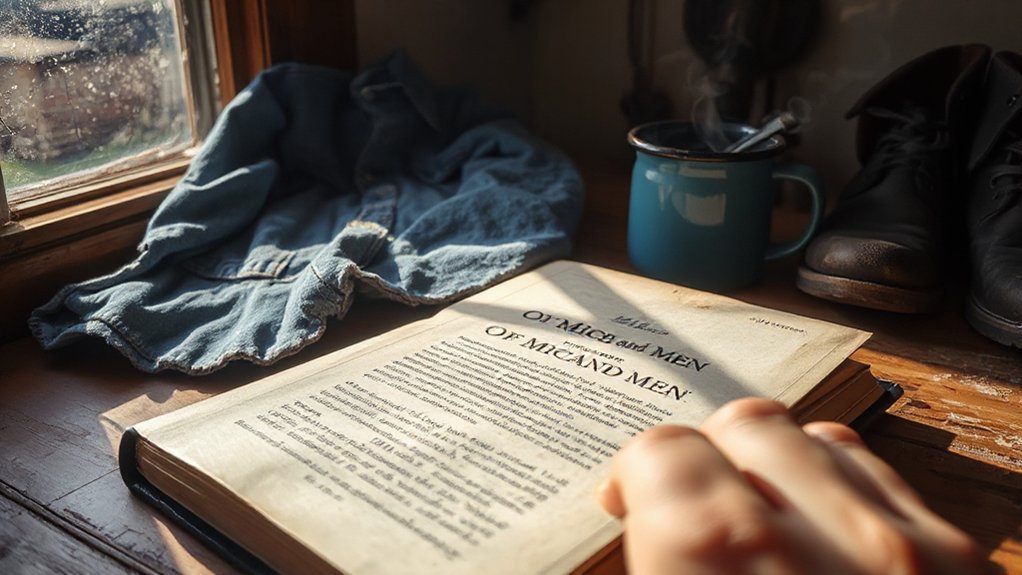
You’ll notice Steinbeck’s sentences hit like a clean punch, short and direct, so you can actually picture dust on boots and sunlight on a shared bunk.
I’ll point out how the prose stays clear, no fancy frills, and how those simple lines make the themes—dreams, loneliness, friendship—feel like things you could touch.
Stick with me, we’ll read a few scenes aloud, laugh at my bad accents, and watch how relatable moments keep pulling you in.
Short, Direct Prose
A few pages into Steinbeck’s Of Mice and Men, I’m hit by how spare and sharp the prose is, like someone trimming hedges with a pocketknife. You feel each word, short prose that hits you in the chest, direct language that refuses to waste breath.
I point, you listen, and the scene unfolds — dust, heat, a bunkhouse chuckling with small cruelties. You’re guided by tight verbs, crisp dialogue, nothing decorative, everything earned.
- Sentences fall like deliberate footsteps, precise, economical.
- Dialogue snaps, reveals, and moves the plot without lecturing.
- Sensory cues — the smell of lunch, the scrape of boots — anchor you instantly.
You’ll read fast, feel grounded, and want to write cleaner yourself.
Clear, Relatable Themes
Hope rings painfully true in Of Mice and Men, and I’ll say it bluntly: Steinbeck makes big ideas feel like things you could hold in your hand.
You follow George and Lennie, you hear their boots, smell dust and kettle steam, and suddenly universal themes become immediate — friendship, loneliness, dreams.
I’ll admit I cried a little, and laughed at my own optimism. You’ll get emotional resonance without slogging through purple prose.
Scenes hit like small sculptures, carved sharp, tactile. Dialogue snaps, characters move like people you’d spot at a diner, and the moral questions linger, warm and sticky.
Read it for clarity, for honest pain, for the weird comfort of truth laid out plain, no frills, no lecturing.
Jane Eyre by Charlotte Brontë

I remember the first time I met Jane Eyre—cold, furious, tiny in a too-big dress, stomping through Gateshead with more backbone than anyone gave her credit for.
You’ll find her voice insistently honest, and you’ll notice character development that feels modern, raw, and quietly revolutionary. The gothic elements thrum in attic shadows and thunderous moors, but the book stays brisk, readable, inventive.
- You’ll connect to Jane’s moral clarity, even when she’s stubbornly wrong.
- You’ll feel the house, the cold, the candle smoke, and the sudden heat of forbidden rooms.
- You’ll admire Brontë’s lean plotting, her emotional leaps, and her risk-taking in a tight, elegant narrative.
Read it, and you’ll be surprised how fresh an old classic can feel.
The Picture of Dorian Gray by Oscar Wilde

Velvet, scandal, and a terrible, beautiful mirror—let me take you right into Oscar Wilde’s sharp little whirl of a novel.
You plunge in, you smell paint and cigar smoke, you watch Dorian pose while his portrait ages for him.
I’ll nudge you toward its clever pace, its witty banter, and the way Wilde’s artistic influences show up in every polished line.
You’ll grin at aphorisms, then wince at choices, because the book asks hard questions about style and substance.
Read it for the cool surface, stay for the moral implications that quietly gnaw.
I’ll confess, I love how it’s both stylish and readable, like a scandal served with tea, you’ll devour it fast.
The Old Man and the Sea by Ernest Hemingway

Salt air and rope burn—there’s your welcome to Hemingway’s lean little sea. You’ll meet Santiago, you’ll row out, you’ll feel salt on your lips and the ache in his hands, and you’ll notice Hemingway’s style: spare, sharp, relentless.
Salt air, rope burn — meet Santiago, row out, taste salt, feel the ache; spare, sharp, relentless craft.
I talk to you like a coach, I joke about my own soft hands, and I push you toward the book’s symbolic elements. You’ll get big ideas through simple acts.
- You sense the sea, tactile, immediate, a machine for meaning.
- You see struggle turned into art, raw and inventive.
- You learn patience, economy of language, how restraint becomes power.
Read it for craft, read it for truth, read it because it moves you.