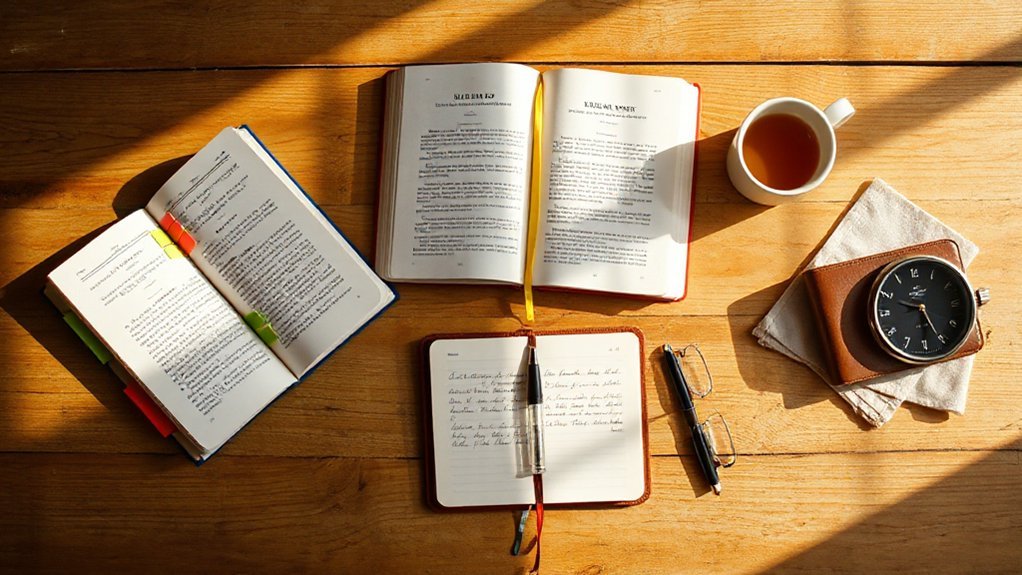
You can juggle three books without turning your brain into mush, I promise — but you’ll need rules. Pick different genres so plots don’t collide, set a tiny goal for each (one chapter, ten minutes), and mark them with a smell or a mug so your mind snaps into gear; I use a cinnamon candle for fiction and a green mug for non‑fiction, because apparently I’m dramatic. Switch at fixed times, jot one-line summaries, and you’ll keep characters straight — now picture the scene where it all goes wrong, and you’ll see why you want a plan…
Key Takeaways
- Pick books with distinct genres, tones, or purposes to reduce overlap and mental interference.
- Assign a clear goal for each book (one-sentence purpose and a measurable milestone).
- Schedule fixed time blocks and sensory cues for switching between books.
- Keep quick tracking notes or mini-profiles (characters, themes, last page) for fast context-refreshing.
- Use varied formats (audiobook, paperback, essays) and revisit notes regularly to reinforce separation.
Choose Complementary Books and Formats

If you want to glide through three books without turning into a frantic, bookmark-juggling octopus, start by picking titles that actually get along.
You’ll match book themes like flavors, so sweet memoir, bright design manual, and sharp sci‑fi mingle without clashing.
Try genre pairing that contrasts form, not tone — a dense theory book, a light novel, and an audiobook for walks.
I tell you, sensing texture matters: paperweight, narration cadence, the smell of ink, the tap of keys on a phone.
Switch formats to reset your brain, and you’ll keep momentum.
Read one in morning light, listen on your commute, skim another before bed.
It’s tactical, playful, and oddly elegant — like arranging snacks for a brilliant, readable party.
Set Clear Goals and Reading Intentions for Each Book

A good goal feels like a tiny compass you can actually follow, so decide what you want from each book before you immerse yourself. I’ll nudge you: name the purpose, jot it down, and stick a sticky note on the spine. Say “sketch ideas,” “learn the recipe,” or “escape for thirty minutes.”
Those reading intentions act like scent trails, pulling you back when attention wanders.
For goal setting, pick one clear outcome per book. Read for insight, for fun, or for skill. Describe it in one sentence, add a metric — a chapter, a concept, a scene — then test it.
If it’s fuzzy, tighten it. You’ll stay curious, focused, and weirdly proud of your tiny, useful victories.
Build a Simple Reading Schedule and Switch Strategy
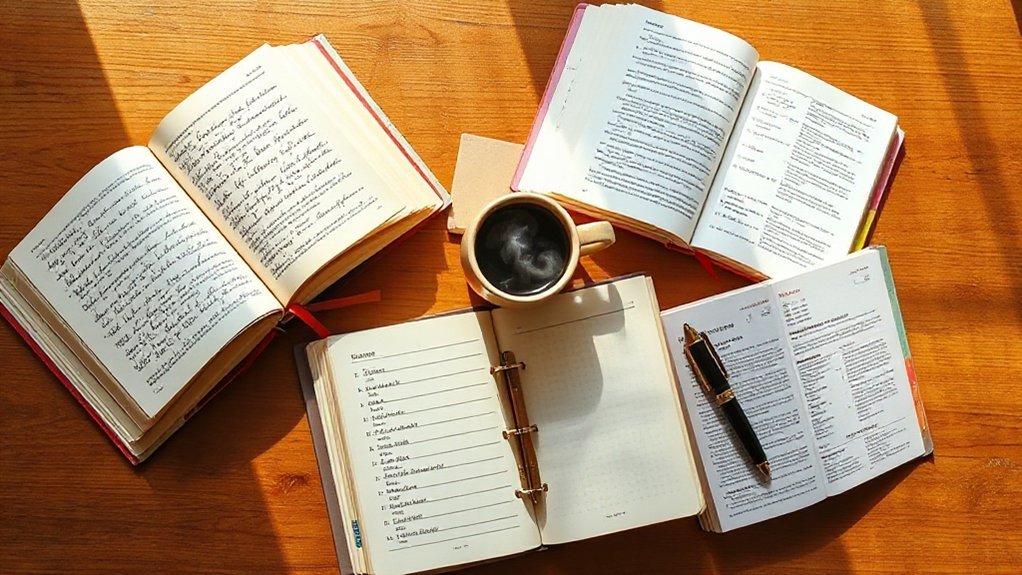
You set aside clear time blocks—15 minutes for essays, 30 for novels, maybe a brisk 10 for poems—and you’ll actually finish more than you think.
I’ll tell you when to switch: a bell, a bookmarked page, or that goofy mental drumroll I use when my focus naps, and you’ll train your brain to hop tracks without face-planting.
Keep it simple, sensory, and a little silly—tea steam, page rustle, soft chair creak—so the cues stick and reading stays fun.
Set Clear Time Blocks
Because your brain likes rules even when it pretends it doesn’t, set clear time blocks for each book and watch your reading life snap into focus.
I tell you, this is pure time management magic. Pick chunks—25, 45, 90 minutes—label them: fiction, work, learning.
You’ll feel the shift, like swapping playlists. Sit down, smell paper or tap the screen, and commit. No guilt, just a timer and a promise.
You’ll boost reading efficiency, you’ll keep momentum, and you’ll stop doom-scrolling during “study” time.
Switch rooms, change mugs, stand up, take a breath, then dive back in. It’s simple, inventively boring in the best way.
Try it for a week, report back, I’ll pretend to be surprised.
Use Consistent Switching Cues
If you want your brain to stop giving you the “which book am I in?” cold stare, set up a tiny ritual to flip between reads and stick to it like gum on a sneaker.
I tap the spine, inhale the paper, and say a one-line prompt out loud — it’s silly, but it works.
You’ll invent switching techniques that feel futuristic, but simple: a song clip for fiction, a notebook flip for nonfiction.
Those sensory mental cues — the smell, the sound, the motion — anchor context fast.
Stick to a schedule, yes, but more importantly, honor the cue.
When the tune plays, you switch. When you close the notebook, you pivot.
It’s decisive, playful, and oddly calming.
Use Quick Tracking Tools to Keep Details Separate

Grab a sticky note, a tiny notebook, or the notes app on your phone and let’s pretend you’re a librarian with commitment issues. You’ll love tracking tools that let you jot a line, tag a mood, or timestamp a quote, fast.
Carry a sticky or notes app like a flaky librarian: quick tags, tiny sketches, and instant book-memory.
I tap, I scribble, I glance back — no fuss. Detail management means each book gets its own mini-profile: character names, odd facts, the chapter where something clicks.
Use colors, initials, or tiny sketches, whatever sparks you. When you switch, you scan your note for three seconds and you’re back in. It’s tactile, visual, immediate, and oddly satisfying.
I promise it keeps threads separate, saves brain space, and makes hopping between books feel like play, not chaos.
Anchor Each Book With a Sensory or Contextual Cue

Think of a smell, a song, or a silly mental snapshot and stick it to each book like a Post-it for your brain — I call this cueing, and you’ll thank me when your brain isn’t doing cartwheels.
I want you to pick bold sensory associations: citrus for a business book, rain for a novel, tinny synth for a how-to.
Say the cue out loud, hum the riff, sniff a matching candle, whatever feels weirdly effective.
Use small contextual reminders too — a colored bookmark, a corner fold, a line in your notebook that ties to a setting or theme.
These gestures anchor meaning fast, they reduce crossover, and they make switching playful.
Trust the ritual; it’s low-effort, high-return, and oddly satisfying.
Review and Reinforce What You’Ve Read Regularly

You’ll want to jot quick daily summaries—two lines on a sticky, or a voice memo while you’re boiling coffee—so the plots and facts stay fresh.
Then, use spaced recall: quiz yourself after a day, a week, a month, like a tiny, merciless librarian who won’t let you forget.
Finally, tie new notes to what you’ve already read, make mental bridges between books, and watch ideas light up like bulbs in a dim room.
Quick Daily Summaries
A few minutes every night will change how much of a book actually sticks with you—trust me, I learned this the hard way, with three half-finished paperbacks and a guilty conscience.
You’ll jot a tiny summary, and suddenly ideas that felt slippery stay put. Use simple summary techniques, and build a habit of daily reflections that’s playful, bold, and oddly satisfying.
- One-sentence takeaway: distill the chapter to its spine.
- Two-minute sensory note: what sounded, smelled, or felt vivid tonight.
- Actionable spark: one thing you’ll try tomorrow.
I talk like a friend who trips over bookmarks, but I mean business.
Do this nightly, you’ll keep momentum, curiosity, and creative fuel humming.
Spaced Recall Practice
You’ve done the tiny nightly summaries, maybe scrawled one-sentence takeaways on a sticky note that now lives under your coffee cup.
I want you to treat that note like a seed. Every few days, pull it out, say the main idea aloud, then test yourself — no peeking.
Use spaced repetition, stretch the interval: tomorrow, three days, a week. It’s simple, brutal, effective.
I’ll admit I forget; so I set phone nudges, tiny rituals — a coffee steam breath, a window click — to cue recall.
This habit turns random lines into neural paths, gives your brain permission to strengthen, then rest.
That’s memory enhancement in action: lightweight, reliable, and oddly satisfying when you surprise yourself remembering something you thought gone.
Connect to Prior Reading
When you tuck a new book under your arm, don’t treat it like a stranger — introduce it to the ones you already know. I poke around, smelling paper, flipping to favorite passages, and I map prior themes onto new pages.
You’ll spot thematic connections, character arcs that echo, and narrative threads that braid across genres.
- Note quick links between genre similarities and author styles, jot a one-line riff.
- Revisit scenes tactilely, say them aloud, test how they change your sense of character arcs.
- Create a tiny visual map, wire the narrative threads, color code for fun.
Do this often, you’ll reinforce memory, spark inventive comparisons, and make reading feel like remixing — messy, thrilling, and smart.