You still love tracing coastline ink with a fingertip, don’t you — that tiny thrill of claiming a place that doesn’t exist yet. I’ll admit, I get a kick out of careless compass roses and rivers that argue with mountains, because maps let you overhear a world’s politics, smells, and grudges all at once. Stay with me, and I’ll show why that paper itch won’t quit.
Key Takeaways
- Physical maps offer tactile, nostalgic engagement that digital tools can’t replicate, strengthening emotional bonds with worlds.
- Maps condense complex worldbuilding, instantly conveying history, politics, and plot seeds for storytellers and players.
- Collaborative mapping workshops and hybrid workflows fuel creativity, rapid iteration, and community-driven narratives.
- Design elements—scale, icons, and weathered fonts—evoke specific moods and guide player expectations and tone.
- Teaching-friendly mixes of handcraft and digital tools make mapmaking accessible, educational, and adaptable to diverse creators.
The Tangible Joy of Handcrafted Worlds

A paper map, honestly, still feels like magic in your hands — the slight crackle when you unfurl it, the faint smell of ink and glue, the way the corner wants to keep folding into your palm.
You trace handcrafted details with a fingertip, delighted, because tactile experience beats a glowing slab sometimes. I’ll admit I get sentimental—call it nostalgic value—yet I’m chasing new angles, artistic expression that riffs on old forms.
You’ll lean in, squint, laugh at a tiny compass rose, then plan a campaign or an exhibit; immersive engagement follows naturally.
Creative exploration happens when you fold, crease, and annotate, making physical artifacts that keep stories close. That personal connection sticks, stubborn and useful, like a stubbornly beloved stain.
Maps as Storytelling Engines

I’ll show you how a single glance at a map can hand you a whole world, the hills whispering histories and the coastlines tasting of salt and exile.
Geography pushes plots—mountain passes force choices, rivers barter cities, and deserts teach stubbornness; you’ll see where conflicts ignite and where secrets hide.
Follow the routes and you’ll meet characters by the tracks they leave, the worn boots, the traded stories, the cowardly shortcut that says more about someone than any speech.
Worldbuilding at a Glance
Even if you only glance at it, a well-drawn map will shout the story at you—mountain ranges hunched like old kings, rivers glittering through valleys like quicksilver, and cities clustered where trade routes smell of spice and coin.
You pick it up, trace a coast, and whole cultures click into place. Maps compress worldbuilding techniques, they fold narrative structures into a single spread, and they let you, the creator, cheat time.
Use them to seed conflict, hint at lost empires, or pin a joke in the margin.
- Establish culture with architecture icons.
- Hide plot hooks in borderlands.
- Layer ecology to suggest history.
I talk aloud, smirk, then point at a ruined fortress — and suddenly, you want to write it.
Geography Shapes Narratives
You spot the ruined fortress and I smirk, but don’t stop there—look at the slopes leading down to the river, the salt crust on the estuary, the thin strip of road that’s been worn smooth by traders’ boots; those shapes don’t just sit pretty, they argue.
You trace a cliff face and you’re told stubbornness, you watch marshes spread and you feel secrets rising, that’s geographical symbolism doing heavy lifting.
I point to a battered coastline, you hear shipwrights cursing wind, you touch the map and it smells of tar and wet stone.
Maps steer tone, they nudge plot, they whisper history before dialogue does; their narrative influence is practical magic.
You read them like a friend, and sometimes, like a conspirator.
Routes Reveal Character
How do the roads tell you who someone is, before they ever open their mouth? I watch routes and read people, you should too. Routes reveal character through choices etched in dirt and stone, showing character journeys with tactile detail — dust on boots, a coin rattling, a careful map crease.
- A straight paved causeway says ambition, efficiency, cold resolve.
- Meandering footpaths whisper curiosity, detours, secret tastes for risk.
- Hidden game trails shout rebellion, urgent escapes, improvised courage.
You’ll map route significance like a detective, noticing pace, pack weight, snack wrappers — small props that speak volumes.
I point, you nod, we laugh at ourselves for trusting roads so much. The map becomes a script, routes the actors, and you, the director.
Grounding Culture, Politics, and Economics

You’ll notice how city names and festival grounds act like tattoos for a people, they mark where accents, recipes, and grudges come from, and I’m not above pointing at a map and saying, “There—your aunt’s pie recipe originates.”
Trade routes slice the landscape like shiny scars, you can almost hear merchant bells and smell spice when caravans climb those passes, and those lines decide which ruler feels rich and which village pays the toll.
Cultural Identity Anchors
Maps are gossiping old friends, and I like to eavesdrop. You trace coastlines with thumb and feel stories stick, cultural heritage humming under your fingertips, identity preservation flashing like beacons. I’ll point, you’ll nod, we’ll invent futures from old scars.
- Borders as memory: they creak, they teach, they anchor myths you wear like a coat.
- Ritual sites: smell of smoke, carved stones, maps pin these totems so you don’t forget how to grieve or celebrate.
- Language pockets: script on a margin, recipes scribbled beside a river, tiny rebellions preserved.
You’ll use maps to argue, to comfort, to prototype new politics. I joke, you listen, we both admit maps feel like home and a dare.
Trade Routes Shaping Politics
When trade winds bend, so do empires, and I want you to feel that tug under your boots — the salt in the air, the rattle of crates on a cart, the whisper of foreign coins.
You trace trade networks on the map, and you see lines that are veins, carrying wealth and gossip, spices and secrets.
I point out how a single road shifts political influence, towns swelling into fortresses, leaders learning to bargain, cheat, charm.
You smell tar and roasted nuts, hear haggling in three tongues, and understand why maps matter.
You’ll redesign borders, reroute caravans, invent tariffs with a grin — because power rides muleback and keel, and your map, dear troublemaker, makes the rules.
Collaborative Play and Community Mapping
If we’re honest, I’ve always loved the chaos of a table full of players—dice clacking, snacks disappearing, someone loudly declaring a dubious territorial claim—and collaborative mapping is where that noise turns into something brilliant.
You immerse yourself in community engagement, feel the hum of group dynamics, and watch shared storytelling become a map. You sketch while someone tells a local lore joke, you erase, you argue, you laugh.
You’ll run map making workshops, use digital platforms for interactive exploration, and fuel creative collaboration that boosts narrative building.
- Host quick, noisy workshops to spark ideas.
- Blend analog sketching with online tools.
- Archive sessions for evolving world lore.
You’ll leave with richer maps and a louder, happier community.
Visual Problem-Solving for Worldbuilders
Because you can’t fix a story’s logic by staring harder at it, I pull out a stack of sticky notes, a worn marker that smells faintly of coffee, and a blank bit of wall to start solving the problem visually.
You join me, skeptical, and we slap notes in ragged columns, sketch rivers that refuse physics, and label mountains with names that make sense.
Visual storytelling turns confusion into patterns you can touch. Mapping techniques let you test cause and effect, move a road, reroute trade, watch a city die or thrive.
You speak aloud, I draw, we argue over a coastline like it’s a family heirloom. It’s messy, loud, joyous.
You leave with a map, not answers, but tools to iterate, fast and fearless.
Aesthetic Appeal and Emotional Resonance
While you’re busy arguing whether that cliff should be called “Bleakspire” or “Breezesnap,” I’m thinking about how the map should feel when someone first lays eyes on it.
You want aesthetic immersion, a pull that makes people pause, and emotional connection, a little shiver when they trace a coastline. I’ll nudge textures, tweak color, and whisper mood into the margins.
- Contrast — bold lines for danger, soft washes for safety, so the eye reads story immediately.
- Scale — big strokes for grandness, fine marks for intimacy, so players feel small or mighty.
- Voice — quirky icons, weathered fonts, subtle scars, so the map talks, jokes, and keeps secrets.
You react, I refine, we invent worlds that feel alive.
Hybrid Workflows: Analog Meets Procedural Tools
You’ve felt the mood of a map—the hush of mist along a fjord, the brassy shout of a sudden cliff—and now let’s get our hands dirty with how we make that feeling stick.
You sketch by hand, ink catching paper, breathe in the smell of charcoal, then feed that scan into procedural generation, watch mountains sprout like mushrooms. You mix analog techniques with modern technology, nudging algorithms, keeping fingerprints.
I joke that I’m half artisan, half code whisperer, but it’s honest: traditional craftsmanship teaches patience, digital integration speeds iteration. You collaborate, artistic collaboration with coders and cartographers, passing markers and scripts across a table.
The result feels alive, a creative synthesis where map evolution happens in studio noise, late-night edits, and triumphant, messy coffee stains.
Education, Accessibility, and Creative Practice
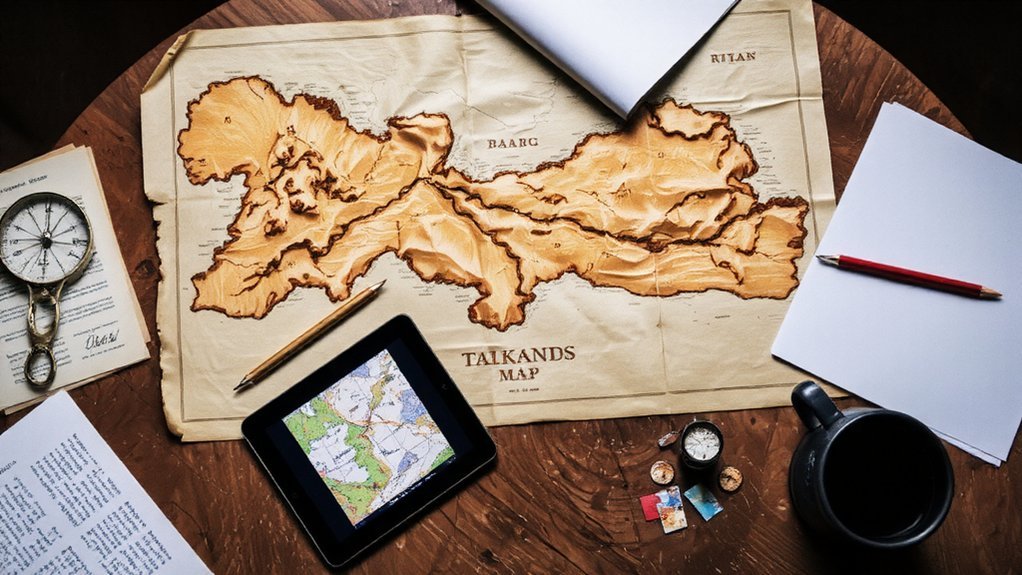
If you want to teach someone mapmaking, start by handing them a pencil and a ridiculous stack of tracing paper — it grounds them, literally, before the software does. I want you to feel paper under thumb, hear the scratch, then watch us switch to tablets, because digital literacy is part of the toolkit. You’ll get experimental, confident, and practical.
- Start tactile, then layer tools, mixing pens, scanners, procedural brushes.
- Build educational resources that pair quick clips with hands-on prompts.
- Foster creative collaboration, small groups, critique that’s kind and sharp.
You’ll confront accessibility barriers, and that’s good — it forces clever workarounds. I’ll show you shortcuts, funny failures, and systems that actually teach.