
You’d think a dusty old novel and a neon dystopia couldn’t be friends, yet here they are on the same shelf, daring you to pick a side. I’ll walk you through the ones that sting, soothe, and haunt—books that make you look up from the page and eye the world differently; I’ll confess favorites, bristle at overhyped bits, and point out where they punch above their weight, so stick around if you want a shortlist that actually helps you decide what to fight through next.
Key Takeaways
- Choose classics that combine timeless themes—justice, love, identity, or power—with vivid characters and enduring cultural impact.
- Include diverse genres: literary realism, dystopia, magical realism, epic poetry, and modern coming-of-age narratives.
- Prioritize books that provoke moral reflection and emotional growth, such as explorations of guilt, empathy, and social conscience.
- Favor works that showcase distinctive narrative voices and stylistic innovation, influencing later writers and readers.
- Select reads that illuminate social class, alienation, human longing, or heroic journeys across different historical and cultural contexts.
To Kill a Mockingbird by Harper Lee

Sunlight slants through a courthouse window, dust motes dancing like tiny jurors — that’s where this book grabs you.
You walk with Scout and feel her small feet scuff the sidewalk, you hear her laugh, you wince at whispered cruelty.
I tell you straight: Harper Lee teaches moral growth without preaching, she shows it in courtroom creaks, in late-night porches, in Atticus’s calm that makes you want to stand taller.
The story stings because it names racial injustice plainly, and then it asks you to act.
You’ll flip pages fast, pause to think, maybe argue with me, then nod.
It’s tender, sharp, oddly funny, and it’ll change how you look at neighbors, and law, and courage.
1984 by George Orwell

You’re standing under a gray sky, rain ticking on the window, and I’ll bet Orwell’s world hits you like a cold draft—surveillance everywhere, fingers on the throat of truth.
You’ll notice how language gets sharpened into a tool, then a weapon, words stripped until they can’t hold a thought.
Sit with that unease, ask the obvious questions, and don’t be surprised if the hair on your neck answers back.
Surveillance and Totalitarianism
If you step into George Orwell’s world, don’t expect polite small talk—expect the telescreens to shout, the posters to leer, and someone to rearrange your memories while you try to make a cup of tea.
You feel the air thicken, wires hum, footsteps echo. I point, you flinch; privacy erosion isn’t abstract here, it’s the scratch on your window, the neighbor’s curt nod that says “I saw you.”
Oppressive regimes breathe through laws and gossip, they map your habits, they turn your kitchen into a checkpoint.
Read it to learn urgency, to catch how small choices resist big machines. I laugh at my own paranoia, but that laugh is nervous, useful.
Keep the book close, and keep asking, who watches you now?
Language as Control
We left the telescreen hum hanging in the air, but don’t think the surveillance ends there—words do the heavy lifting. I watch you scan signs, adverts, speeches, and you’ll spot how language manipulation trims choices, reshapes desire, and quietly fences your mind.
You feel the taste of words, metallic and slick, as they bend truth.
- Notice euphemisms that soften the blow.
- Track slogans that compress thought.
- Hear cadence that soothes, then steers.
- Spot omissions that erase possibility.
I guide you through linguistic power like a lab, we poke phrases, measure their pull, and laugh when we catch the obvious trick.
You’ll leave equipped, skeptical, and oddly excited to rewrite the rules.
Pride and Prejudice by Jane Austen

Pride’s first line hits like a polite slap: “It is a truth universally acknowledged…” I’ll admit I grin every time I read it, because Jane Austen doesn’t waste breath—she sets the whole room with one crisp sentence, and you can practically hear corsets squeak and teacups clink.
Pride’s opening lands like a polite slap—one crisp line and the whole drawing room is alive.
You step into ballroom glare and muddy lanes, you taste lemon tart and simmering vexation, and you notice how social class hums beneath every bow.
You’ll watch Elizabeth dart sharp, funny lines, and Darcy brood, shift, and reveal himself. The romantic tension clicks like a well-oiled hinge, you laugh, you wince, you root.
I’ll nudge you: read it for the wit, for the slow unmasking, for the joy of being surprised.
One Hundred Years of Solitude by Gabriel García Márquez
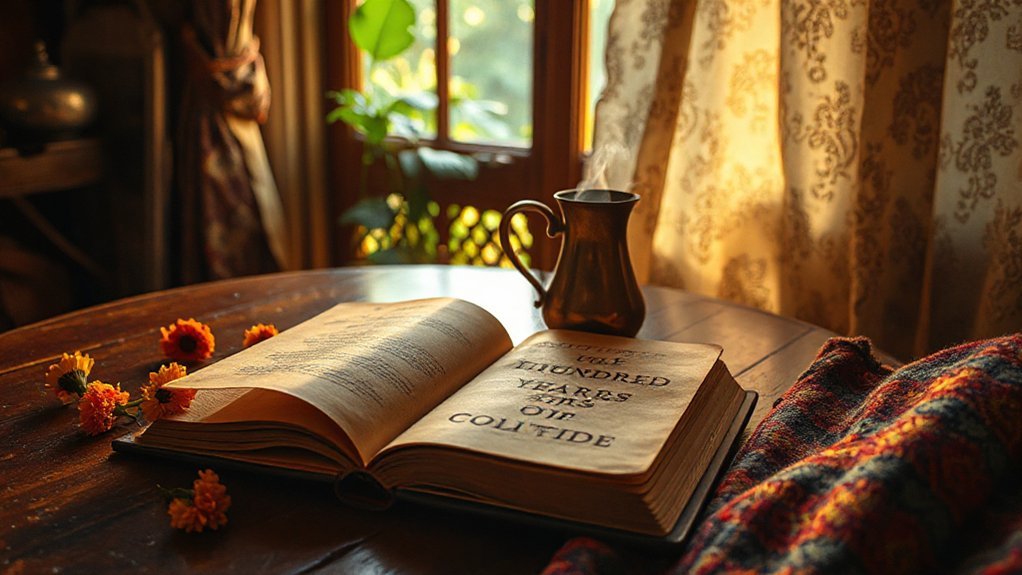
When I opened One Hundred Years of Solitude I felt like I’d walked into a house that refuses to stop telling stories, every room crowded with relatives, ghosts, and the smell of banana leaves frying in oil.
You’ll follow Buendía hands and stubborn hearts, you’ll sip coffee stained with prophecy, and you’ll grin at wild, inventive scenes that rewrite what a novel can do.
Its magical realism bends reality, but it’s grounded by an urgent family legacy that keeps you turning pages.
- vivid atmosphere that teaches bold invention
- characters who feel like bold experiments
- language that sparks design-thinking in prose
- pacing that loops, surprises, and rewards
Read it if you crave risk, memory, and myth.
The Great Gatsby by F. Scott Fitzgerald

If Márquez piled a house with ghosts and banana-scented chaos, Fitzgerald sets a single, sunburnt lawn on fire with longing and champagne.
You stroll past Gatsby’s luminous parties, you taste citrus and cigarette smoke, you hear a jazz trumpet that tugs at your ribcage.
I tell you, it’s about the American Dream, but not the glossy ad version — it’s the ache beneath it, the reach for something impossible.
It’s about the American Dream — not the glossy ad, but the aching reach for the impossible.
You watch Social Class slice the crowd into islands, you notice the green light blinking like a dare.
I’ll admit I’m charmed and annoyed, sometimes both; Fitzgerald makes you root and recoil.
Read it to feel elegant ruin, to learn how desire dresses up as hope.
Beloved by Toni Morrison

I want you to meet Beloved, Toni Morrison’s fierce, haunted novel that grabs identity by the collar and won’t let go.
You’ll feel language like a knife and a lullaby, memories simmering in the kitchen, the creek, the clothes—every word doing work, none wasted.
Read it aloud, whisper it, argue with it, because it asks you who you’re and makes you answer, awkwardly, honestly, and with your whole mouth.
Themes of Identity
Because you can’t talk about Beloved without getting a little messy, I’ll jump right in: Toni Morrison drags identity into the open like a stubborn old coat, shakes it out, and shows you every tear and patch.
You watch, squirm, and learn, because identity exploration here isn’t neat. You feel the weight, the smell of old fabric, the tug of memory, and you can’t look away. You’re prompted toward personal growth, but it’s gritty, honest work.
- You confront fractured selves, bold and raw.
- You see survival shaping who you become.
- You face community, secrets, and rebirth.
- You reckon with choices that echo.
I’ll hold your hand, then nudge you off the porch.
Language and Memory
When memory speaks in Beloved, it doesn’t whisper — it spits, sings, and sometimes screams, and you’re left holding the echoes.
I watch language do heavy lifting, you feel every syllable like a weight, like a feather too, both at once.
Morrison rewires language acquisition, she toys with how words become you, how names stitch wounds shut or tear them open.
You trace memory retention in breath, in a child’s laugh, in the clack of a spoon on a plate.
I’ll nudge you: listen to how dialogue clots and frees, how repetition becomes a pulse.
We joke to keep from crying, and it works, until it doesn’t.
You leave changed, vocabulary sharpened, heart a little louder.
Crime and Punishment by Fyodor Dostoevsky

If you think you’re ready for a book that will pry at your conscience like a nosy neighbor, good — you’re half right and about to be proven gloriously wrong.
I tell you, Dostoevsky drags you into St. Petersburg’s dust, into cramped rooms, into a mind that hums with moral dilemmas and psychological exploration. You’ll pace, you’ll gasp, you’ll squirm, and you’ll love the ache.
Dostoevsky drags you into St. Petersburg’s dust—cramped rooms, buzzing minds, moral ache you’ll crave.
- Intense interior monologue that feels like eavesdropping.
- Moral puzzles that won’t let you sleep.
- Vivid cityscapes, rain, and the smell of boiled cabbage.
- A revolution in empathy, bold and unsettling.
I’ll nudge you, insult you gently, then watch you rethink justice, guilt, and the weird kindness inside cruelty.
The Catcher in the Rye by J.D. Salinger

You’re going to meet Holden Caulfield through his cranky, razor-sharp voice, and you’ll hear him in your head, complaining and noticing every little phoniness.
You’ll feel that tug of alienation, like cold wind on your neck in a lonely subway station, and you’ll watch how his mistrust of adults shapes everything he touches.
I’ll admit, I’m biased — this book rewired how teens spoke on the page, and you’ll spot its fingerprints all over modern young-adult fiction.
Holden Caulfield’s Voice
Okay, listen: I’m not here to moralize, I’m here to talk—loudly—about Holden Caulfield’s voice, that raspy, stubborn thing that grabs you by the collar and won’t let go.
You feel it immediately, like cigarette smoke in a small room, witty, wounded, inventive. Holden’s cynicism hits like a snap, his loneliness hums under every joke, and you’re pulled into his head, messy but brilliant.
- sardonic narrating, like a friend who tells truth bluntly
- vivid, conversational details, you smell the city, hear footsteps
- inventive rhythms, sentences that dance and stagger
- blunt humor, self-aware lines that make you grin and wince
You’ll ride his voice, learn to listen, and come away energized.
Themes of Alienation
When I say Holden’s loneliness, I mean the kind that smells like wet coats and stale coffee — it’s physical, sticky, impossible to shake.
You walk his streets, you hear his mutters, and you feel an existential crisis twitch under your ribs, like a streetlight buzzing. He rebels with words, not violence, scuffs at phoniness, and drags you through subway platforms, diner booths, rain-slick sidewalks.
You recognize the societal disconnect he names, the gap between your private truth and the world’s script. I narrate, I joke, I wince with him, offering blunt scenes: a terse conversation, a slammed door, a sob caught behind a laugh.
You leave changed, oddly soothed, wiser and slightly unsettled — in a good way.
Influence on Young Adult
Anyone who’s ever stomped through high school halls with a backpack full of questions owes a little debt to Holden Caulfield — I know I do, and I’ll admit it without drama.
You’ll spot his influence in every nervous glance, every snarky aside, in coming of age stories that refuse neat endings. You feel the grain of cafeteria trays, the scrape of sneakers, the thump of a heart that won’t behave.
I’ll say it plain: Salinger taught you to question adults, to face moral dilemmas, and to care without permission.
- raw voice that tells truth, warts and all
- teens who distrust tidy answers
- terse narration that sparks innovation
- scenes that smell like winter, milk, and truth
The Odyssey by Homer

If you’re the sort of person who loves a good escape story, then let me drag you onto Odysseus’ ship—figuratively, of course—and promise we’ll snag a few monsters, a jealous god, and some stubborn nostos along the way.
You ride an epic journey, feel the salt, hear waves slap the hull, and watch Greek mythology spring vivid and strange. You’ll root for heroic struggle, chuckle at clever tricks, wince at loss.
I narrate scenes, toss in snappy asides, and point to the Odyssey’s legacy, its literary influence on narrative structure and character development. Divine intervention pops up like an annoying plot device, but it shapes timeless themes.
I narrate vivid scenes, crack snappy asides, and trace the Odyssey’s legacy—divine meddling included, shaping timeless themes.
Its cultural impact echoes everywhere; read it, and you’ll see why it still matters.
The Brothers Karamazov by Fyodor Dostoevsky

Family drama, but grander and darker than your worst Thanksgiving—I’m dragging you into Fyodor Dostoevsky’s noisy, aching house of the Karamazovs.
You step in, smell pipe smoke and damp books, and I point at the chaos. You’ll face moral dilemmas, relentless questions, and a philosophical exploration that tweaks your brain.
- Brothers who bicker, love, and betray.
- A murder that rattles every conscience.
- Sermons and bar fights that reveal souls.
- Conversations that keep you up, smiling and unsettled.
I guide you through scenes, I joke, I wince.
You’ll meet fathers who scream, sons who whisper, and truths that sting. It’s dense, alive, urgent, and oddly freeing—read it, argue with it, change.
Leave a Reply